Showing posts with label greek mythology. Show all posts

Greek Mythology Behind the Southern Hemisphere Zodiac Signs

By 


"What is your sign?", is the number one question that everyone has been asking. Many may see this question as a pick-up line but some people are really interested in knowing our Zodiac Sign. Maybe because our Zodiac Sign has been said to help us better understand each other's personality and traits. There are 12 Signs in the Greek Zodiac. Zodiac means "circle of animals" in Greek, although the 12 signs are composed of animals and humans, with the exception of Libra. There is an interesting and fun Greek Mythology behind each of our Signs. The Greek Myths behind each of the Southern Hemisphere Zodiac Signs, which include Libra, Scorpio, Sagittarius, Capricorn, Aquarius and Pisces, are as follow:
Libra - the Libra Sign is represented by scales, which Egyptians believed were used to weigh the souls of the dead. However, in Greek Mythology, Libra actually represented the golden chariot of Pluto (Hades). Pluto was the brother of Zeus and ruler of the underworld. One day he spotted a beautiful girl named Persephone, while riding into the Upper World with his golden chariot, which was pulled by four jet-black horses, Persephone was the daughter of Zeus and Demeter, the goddess of the harvest. Pluto was so mesmerized by her beauty that he quickly forced her into his chariot and carried her away to the Underworld and made her, his Queen. Demeter became so depressed about the kidnapping of her daughter that she could not pursue with her godly duties. Zeus demanded that this brother Pluto returned the girl back to the Upper World. Pluto agreed, just as long as his Queen would divide her time between the two worlds, four months of the year.
Scorpio - the Scorpio Sign represents a giant Scorpion. The myth begins with a giant hunter named Orion. He was very handsome and this made him think very highly of himself. He had no respect for the immortals and started to brag about how better of an anchor he was than Artemis and how he would be able to kill every animal he encountered. Artemis was the goddess of the wilderness and she became very angry at Orion and decided to call his bluff. She sent a giant Scorpion to deal with Orion. The fight was pretty intense but the Scorpion was able to defeat Orion. Zeus, the king of the gods, was so impressed with the whole duel that he placed the Scorpion in the high heavens.
Sagittarius - the Sagittarius Sign is represented by a Centaur named Chiron. In Greek Mythology, Centaurs were half-man and half-horse. They were known to cause great trouble, except for a gentle Centaur named Chiron. He was very kind and an excellent anchor and physician. Unfortunately, Hercules had mistaken Chiron for one of the evil Centaurs he was battling and accidentally shot Chiron in the heart with a poisoned arrow. The arrow caused Chiron such great pain that he offered to take place of a man named Prometheus and become mortal. Prometheus was a Titan who had stolen fire from Zeus and was punished greatly for it. Prometheus was chained up to a rock by Zeus and every morning an eagle would eat his liver. The liver would grow back the next day and once again be eaten. Chiron decided that a few minutes of pain was much better than a life-time of agony and so he took the place of Prometheus.
Capricorn - the Capricorn Sign is represented by a goat named Pan. In Mythology, Pan was being chased by the god of dangerous winds, Typhoeus. Pan had no choice but to jump into the Nile River. Little did Pan know, the Nile River was very powerful. The Nile River was able to turn Pan's lower half to a fish while his other half remained a goat. Pan was then able to quickly swim away and escape Typhoeus.
Aquarius - the Aquarius Sign is represented by the Cupbearer. There was a young boy named Ganymede. He was son of Tros, the King of Troy. Zeus took a liking for the young boy and decided to kidnap Ganymede and take him to the heavens. One day while Ganymede was attending his father's sheep, Zeus turned into an eagle and swooped the boy away. Ganymede then became the Cupbearer for the gods.
Pisces - the Pisces Sign represents a pair of fish. Typhoeus once again was terrorizing the gods and was trying to scare them away. The gods immediately turned into animals, wanting to escape this evil monster. Aphrodite and her son Euro ran to the river and quickly turned into a pair of fish with cords attached to their tails. The cord kept the two together and they swam away safety.

Represent your sign with the Astrology Bedding Duvet Set from Bedroom Duvet Spot.


The Greek Myth of the Six Northern Zodiac Signs


The Greek Zodiac Signs were identified with groups of stars called Constellations. The stars would form an imaginary shape in the sky, just like an image that would form when we played the puzzle game, Connect the Dots. The Greek Zodiac is composed of Northern and Southern Signs. The Northern Signs are Aries, Taurus, Gemini, Cancer, Leo, Virgo. There is a Greek Myth behind each Sign. Here are some of the interesting Myths behind the 6 Northern Zodiac Signs:
Aries - a Golden Ram represents the Aries Sign. The myth begins with two sibling children, Phrixus and Helle. The children's mother, Nephele, dies and their father, King Athamas, remarried a woman named Ino. She was very envious of the children and quickly planned to get rid of them for good. She spread disease amongst the crops of the land, so that the crops would fail. The King saw the crops and could not understand why they had failed, so he sent two messengers to ask the Gods for help. Ino bribed the messengers in telling the King that his two children, Phrixus and Helle, would have to be sacrificed in order for the gods to save the crops. Nephele was watching from the heavens and immediately sent a golden ram to rescue her children and have the golden ram take them away to a far and safe place. The children quickly mounted the golden ram and Phrixus was saved but unfortunately Helle could not hold on much longer and fell into a body of water, which is still called Hellespont.
Taurus - the Minotaur represents the Taurus Sign. In Myth, a man named Minos promised to sacrifice a beautiful white bull for the god Poseidon. Minos decides to kill another bull instead and tricks Poseidon into thinking that it was the beautiful white bull. Poseidon becomes very upset and asks Venus to catch a spell onto Minos wife. The spell made Minos wife fall madly in love with the white bull. Minotaur became the offspring of both. Minotaur had the head of a bull and the body of a man. Minotaur was very dangerous and had to be kept behind an elaborate maze. Minotaur was feed children and maidens. In order to save the children and maidens, a brave prince named Theseus tied one end of the rope onto his waist and the other end to a tree. He then killed the Minotaur with a sword and found his way out of the maze with the rope.
Gemini - a pair of twins represents the Gemini Sign. Twin brothers Castor and Pollux were inseparable. They both had the same mother but Pollux was immortal because he was son of Zeus, the king of gods. Castor was not. He was son of a mortal. When Castor died, Pollux begged his father to let him be mortal as well, that way he can die alongside his brother. Zeus did not want his son to die so he made a deal. He will bring Pollux to life as long as Castor agrees to share his brothers mortality. While one brother is alive, the other will be dead and vice versa. Zeus will also allow both brothers to spend small amounts of time together and so Castor agreed.
Cancer - a giant crab represents the Cancer Sign. In Mythology, Zeus had an affair with the queen of Tiryns, Alcmene. This affair lead to the birth of Hercules. Hera, the wife of Zeus, was so angry about the whole affair that she did everything in her power to destroy the child of Zeus and Alcmene. Hercules was a powerful man and trying to destroy him was not an easy task. In his twelve labours he encountered the nine-headed water serpent Hydra. Hera immediately sent a giant crab named Cancer, to help the water serpent destroy Hercules but they were no match. Hercules smashed the crabs shell with his foot and killed the nine-headed water serpent.
Leo - a powerful lion represents the Leo Sign. The Myth begins with a strong and fierce lion named Nemean. Nemean roamed the land of Argolis and killed anything or anyone that crossed his past. His claws were sharper than any mortal sword and his tough skin was imperious to metal, stone and wood. He was the first of Hercules twelve labours. Hercules managed to strangle the lion to death. Hercules skinned the animal with its own sharp claws and used it as a mighty cloak.
Virgo - represents the virgin goddess Artemis. In Greek Mythology, gods and humans once lived together in harmony during the golden age. Unfortunately this ended, as the gods wanted to assume the role of superiority. Pandora unleashed a box of evil demons and all the gods fled from Earth. Pandora was the first woman formed by the gods. The goddess Artemis loved being on earth and had shared her knowledge about the gods with the humans but was forced to leave because of the evil demons.

Represent your Northern Sign with the Leo Zodiac Bedding Set from the Arya Collection at Bedroom Duvet Spot.


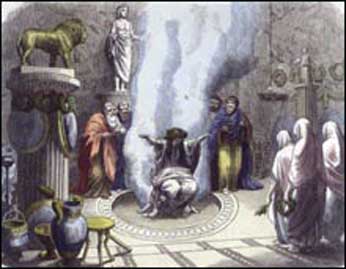
Delphic Oracle - Ancient Greece


The first diviner to occupy the Delphic oracle was the mother of the gods, Gaia. She was succeeded by her daughter, Themis. The third occupant was another daughter of Gaia, the Titaness Phoibe, who gave Apollo the surname of Phoibos as a birthday present. We have this information from the Pythia's own mouth, in the opening lines of Aischylos' tragedy Eumenides. As regards the rest of the story: how Apollo founded his first temple at Delphi, and how he slew the fearful dragon (a female serpent) near a spring, this is recounted in the ancient Homeric hymn to Apollo. In later times, men believed this serpent to have been male and even more redoubtable, none other than the famous Python, guardian of Gaia's oracle; the battle that the young god who had come from the north - from the valley of Tempe - fought against the serpent was indeed a great and terrible one. They also believed that although a god, Apollo complied to the divine rule which he himself had set: that whoever defiled his hands with the blood of murder should be sent into exile. Thus the god departed for eight years and worked in the service of Admetos, King of Pherai, in order to cleanse himself of the pestilent blood of murder; then he returned, purified and clean at last, sole master of the Delphic oracle.
This is what the ancients had to say about the beginnings of the legendary oracle. But concerning the site itself, that unique site which overwhelms whoever visits it for the first time, they had another story to tell. Zeus, wishing to find the centre of the earth, let loose two eagles from the two ends of the world; the sacred birds met at Delphi, which meant that there was the "navel" of the earth. Hence, Apollo's sanctuary contained, since remotest times, an omphalos (navel-stone), and votive offerings in the shape of the omphalos were presented to the god by pious pilgrims from all over the world. The Apollonian oracle was indeed celebrated and venerated throughout the inhabited world. Not only Greeks, but barbarian monarchs as well sent envoys to consult the oracle and expressed their gratitude by dedicating sumptuous gifts and votive offerings to the god.
The Site: Such are the myths of the ancients concerning Apollo, Delphi and the celebrated oracle. However, before we come to the Delphic sanctuary and speak of the Delphic cult, we must first take a look at the place itself - the place which was once behind to be the centre of the earth. The usual approach to Delphi by land is by means of the road climbing up from Boiotia towards Arachova and then descending westward; it is the same road which the god himself followed when he first came to Delphi, as we are informed by the Homeric hymn to Apollo. Another approach is by means of the Corinthian gulf, and that was the one used by the first priests of Apollo, who were Cretans. Now the visitor encounters a landscape vividly described in the Homeric hymn: "You climbed rapidly (Phoibos is being addressed here) running across the hill-tops and you reached the regions of Krisa below Mount Parnassos which is covered with much snow, at the point where it forms a knee to the west, and a large rock overhangs the spot, while below a wild valley stretches out; this was the spot where the Lord Phoibos Apollo decided to have a beautiful temple..."
Anybody coming upon the holy site for the first time is struck with awe. "It is as if the earth had been cleft asunder by some cosmogonic spasm; the valley is a vast and profound chasm... And as soon as we reach the foot of the Phaidriades, at the exact spot of the Kastalian Spring, we are faced with something that appears like the chasm of chasms: the two rocks are separated by a tremendous gorge, narrow and impassable - the Arkoudorema (the Bear's Gully) as it is known today - which continues all the way down the slope, deep into the thicket". And there, at the point where the two rocks meet, in the deepest recess of the gorge and at the foot of the east rock (known anciently as Hyampeia and presently as Flempoukos), the most limpid water gushes forth: it is the water of the celebrated Kastalian Fountain where both priests and pilgrims cleansed themselves before entering the temple. On the western side, at the foot of the rock named Rhodini, Apollo's sanctuary, the most famous in ancient Greece, extends across the opening on the rising ground. And down below, the deep valley of the Pleistos river spreads out, green and silver with olive-groves, and merges with the plain of Itea stretching all the way down to the sea-coast.
The history of Delphi: The history of Delphi is inextricably bound with the history of the sanctuary and the oracle; to be more precise, Delphi only existed as a township under the shadow of the sanctuary. Archaeological excavations have revealed the existence of an insignificant settlement on the site of the sanctuary and further east, dating back to c. 1400 B.C. This settlement was destroyed at the end of the Mycenaean period, but came back to life in Geometric times, when Apollo's cult began to take root in that region. Hence-forward, Delphi acquired world fame and power of a kind unparalleled in Greece, although it remained a small town, sparsely populated. Over the course of 250 years, four sacred wars were waged for this small town, and at the end it caused the annihilation of the Phokians.


The Mystery Of Orpheus

By 

The myths associated with the musician Orpheus are some of the best known of the Greek and Roman myths. But underlying the various versions of the myth are contradictions, or complementary opposites, that make Orpheus the uniter of dualities.
Orpheus is son of Calliope, the Muse of epic poetry, and the ancient Thracian king Oeagrus. Apollo teaches him to play the lyre as a child. His legendary singing and musical skill moves stones and trees and calms wild beasts. Jason recruits Orpheus to join the Argonauts in the quest for the Golden Fleece, because Orpheus will be able to silence the beautiful singing of the Sirens so the ship can safely pass without being lured onto the rocks.
After returning from the voyage, his bride, Eurydice, is bitten by a snake during their wedding and dies. Orpheus travels to the underworld, where his doleful music about his loss moves everyone to tears, thus convincing Hades to let Eurydice live again, but only if Orpheus promises not to gaze back upon her until he reaches the upper world. When he turns around during their ascent to make sure she is following, however, she slips permanently back into the Underworld.
The death of Orpheus branches out into different stories that are wildly contradictory. According to one version of the myth, he is so disconsolate with grief over Eurydice that he kills himself. In another version, he turns to the love of young males for consolation. The Thracian women known as the Maenads, initiates of the secret female mysteries of the god Bacchus, are mad with fury at being scorned by him, and attack him. Or, according to another branch, perhaps they attack him because he has gazed upon their secret rites. At first, the sticks and rocks refuse to strike him because those inanimate objects are charmed by his music. But the clamor of the Maenads' music, with its drums, howls, and flutes made from broken horns, drowns out his gentle lyre, and he is torn limb from limb.
In yet another version of the myth, Orpheus travels to Egypt where he learns about these mystic rites of Bacchus (which are related to the Egyptian rites of Osiris), and introduces the cult to Thrace. Or he brings the rites back from the land of Lydia in the east (now part of Turkey) or beyond. (In Greek musical theory, the Lydian mode, named after the kingdom of Lydia, equates to the notes of the major scale, which became the basis of European music and is now common throughout the world.)
The myth then branches again, and Orpheus was either struck with lightning by Zeus for having revealed the mysteries of the gods to men, or he turned his back on Bacchus and, perhaps to honor the one who gave him music, began worshipping Apollo as the sole deity, which caused a jealous Bacchus to incite the Maenads to kill Orpheus in revenge.
So we have a variety of deaths for a variety of reasons, and the commingling of dualities. This iconic musician becomes associated with both the birth of an exotic cult and death at the hands of an exotic cult. He becomes associated with life - bringing stones to life, stirring men and beasts alike through music - and with death - his visit to the Underworld, the Egyptian cult of Osiris. He becomes associated with tragic love: through the loss of his beloved Eurydice not once but twice, and through sacrificing his life because of his love for men. He becomes associated with worshipping the Apollonian spirit -rational, orderly - and with worshipping the Dionysian spirit - irrational, ecstatic. There is even a polarity between the refined artistry of his playing and the clamorous music of the Bacchants.
A style of poetry developed that was attributed to Orpheus. This Orphic poetry was recited in mystery rites and purification rituals. Plato mentions in "The Republic" a class of vagrant beggar priests who were devoted to these rituals and offered purifications to the rich. Followers of the Orphic way of life often practiced vegetarianism and, interestingly enough, abstention from sex (perhaps they feared the vengeance of the Maenads). It's also interesting that Bacchants were frequently associated with orgiastic practices, but Euripides makes it clear in his play, "The Bacchae," that the Bacchants were chaste. So again, we have a contrast between wild abandon and restraint.
All of these polarities coexist in Orpheus. He represents life and death, order and ecstasy, abandon and restraint. And at the heart of it all is music, possessing an almost supernatural power, a gift from the gods.
More music articles at Song of Fire (obergh.net/songoffire)


Greek Mythology Hercules - The Mortal Who Became a God


When Hercules was born to Alcmene, she named him Herakles. But in Roman, Herakles is pronounced Hercules, which is the name we use for Hercules to this day. Hercules in Greek mythology is a great figure of valor and muscle strength. Hercules bravery earned him a place among the gods. After he left the mortal world, he found a position on Mount Olympus, the gods' dwelling place.
Zeus, the King of the gods was an unfaithful husband. He had a weakness for worldly pleasures. He fell in love with Alcmene, the wife of Amphitryon. In a short time, Alcmene conceived Hercules. This angered Hera and she tried to kill Hercules. Hercules survived his first fatal assault with a miracle.
When Hercules reached adulthood he became a famous warrior. He also fell in love with a beautiful woman called Megara. Megara became the mother of Hercules' children and together they made a happy family. However, things were to be different. Hera took a vow to irritate Hercules during his lifetime. She tricked Hercules into a wild rage. In his rage, the mortal god Hercules killed his family. This was exactly what Hera wanted!
When Hercules returned to his normal state of mind, he saw things were beyond remedy. He prayed to Apollo to get rid of his crime. Apollo was the sun god who could read into the future. We find in Greek Mythology that Hercules requested his advice. Apollo assigned him ten important tasks (later it was turned to twelve) as the way of purifying his soul.
The Delphic oracle sent him to Tiryns where the king Eurystheus ruled. Hercules was expected to serve him as laborer for twelve years of his life. However, the difficult service was not fruitless. Apollo promised him immortality. He was to become a god. However, the great Hercules of greek mythology had one problem, Hera. She actually kept her promise to make Hercules' life as wretched as she could. Nevertheless, with the assistance of Hermes and Athena, Hercules pulled off his term of twelve years with excellence. In addition, he became the greatest mortal on the earth to become a god.
Hercules In Greek Mythology - What Made Him So Special?
The honorable penance of Hercules and his eventual success is what makes him so special. His success brought him immortality, which would have been unthinkable for ordinary mortals. Hercules' first task was to peel off the skin of the horrifying Nemean Lion after capturing one. His next task was to kill The Lernean Hydra. The Lernean Hydra was a serpent with nine heads, which never gave peace to the lives of those around it. The third task for him was to bring a Hind (a sacred red deer) from Ceryneia to the king. The deer was the pet of Diana, the Moon goddess.
The fourth task for Hercules was to bring a live Erymanthian Boar. It was very dangerous to men and animals living around the mountain Erymanthus. Then Hercules was asked to clean up King Augeas' stables in one day. Are you thinking what is so great about it? King Augeas had an awesome amount of cattle of cows, bulls, goats, sheep and horses. Hercules proposed to King Augeas that he would clean the stable only if he rewarded Hercules with a tenth of his cattle.
After this success, Eurystheus was planning to make something tougher for Hercules. He commanded Hercules to force out an enormous flock of birds, which assembled at a lake near the town of Stymphalos. Goddess Athena helped him with a pair of bronze krotala, an item similiar to castanets. The Cretan Bull was an easy task for Hercules. Hercules wrestled the bull, and then delivered it back to King Eurystheus.
The eighth task was to bring the Man-Eating Horses of Diomedes. It was followed by the battle against the Amazonian female army to get the belt of Hippolyte, the queen. The tenth labor was an awesome one. Hercules had to go around the world, to bring the cattle of the Monster Geryon. It had three heads and three sets of legs all attached at the waist.
The tricky assignment was the eleventh one. Eurystheus asked Hercules to get the Apples of the Hesperides. These were the golden apples gifted by Hera to Zeus. These apples were strictly guarded by a hundred-headed dragon, named Ladon, and also by Hesperides, daughters of Atlas. The other obstacle was that Hercules had no idea where these apples of Hesperides were located. Eventually, Hercules found the location from Nereus whom he seized until Nereus gave him the location of the apples of Hesperides.
Then Hercules found out through Prometheus, whom Hercules had helped, that he would have to have Atlas retrieve the apples. Hercules agreed to hold the sky and the earth while Atlas retrieved the apples. When Atlas returned with the apples, he told Hercules that if he would hold the sky and earth for the rest of time, that he would take them to Eurystheus himself. But Hercules fooled Atlas by asking him to hold the earth until he padded his shoulders. Atlas took Hercules place holding the earth, and Hercules picked up the apples and ran.
After making the great Hercules do all sorts of unbelievable errands, Eurystheus made sure that he did not succeed the last time. So, he ordered Hercules to abduct Cerberus, the underworld beast. Did you ever hear a living man visiting the Hades? However, Greek mythology tells us Hercules was no ordinary man. He was a hero.
He eventually did complete all the tasks, purified his soul and rescued the princess of Troy from a ravenous sea-monster. He also facilitated Zeus to beat the Giants in a great battle for the control of Olympus. He married again, to the charming Deianira. She presented him a cloak, which was coated with what she mistakenly thought to be a magic love potion. She was told that the balm would make the person love her forever.
Ironically, it was poison, which burned Hercules skin. Hercules, not being able to endure the pain asked his friends to kindle a fire. Then Hercules placed himself on the fire to be burned up alive. But the gods looked down, and Zeus thought that Hercules had suffered enough. So he asked Hera to end her anger toward Hercules, which she did. Then Hercules was brought to Olympus in Athena's chariot by Zeus' request.
This Greek mortal Hercules is undoubtedly the greatest hero of Greek Mythology. Hercules is still considered to be the perfect mythical character.
© Copyright Randy Wilson, All Rights Reserved.
Randy currently has a website dealing with Reviews of Coffee Related Products such as coffee makers, espresso makers, coffee, k-cups, and more plus articles on coffee enemas and other coffee and health related topics. He also has a website of Reviews of Small Appliances [http://www.smallappliancebuyerguides.com/] such as ice cream makers, vacuum cleaners, mixers, irons, toasters, food processors, and many other appliances.


The Greek Sphinx - A Demon Of Death And Esoteric Wisdom


The Sphinx is best described as a symbol of "arcane wisdom" (Olderr 126), and wicked power in ancient Greece around 1200 BCE. Her disposition is depicted by the mythical story associated with her, specifically, her interactions with Oedipus . The Sphinx had also existed much earlier with other meanings in cultures such as Egypt. Since that time, its symbolism has become so captivating that its meaning is almost proverbial in the Western World today (Britannica 16).
The Sphinx truly fits her title as a beast. In the Greek legend, the Sphinx is a female symbol with the body and feet of a lion, the head and breasts of a woman, and the wings of an eagle (Scafella 179). Albeit the sphinx literally described sounds hideous, the visual portrayals of ancient Greece are nonetheless enticing. Such representations most commonly appeared on ivories, painted plaques, and pottery (Britannica 16). Although there are many representations of the sphinx, for the purposes of this essay, the example used is the Greek Sphinx seated on a short ionic column before Oedipus. This representation is painted on an Athenian vase from the Archaic Period in Greece, between 800 and 500 BCE (Boardman 246).
The name "Sphinx" is a Greek name derived from the verb sphiggein, which means "to draw tight or to bind together" (qtd. in Scafella 179). Her myth is well described by Albert E. Cowdrey in his fictional story The Name of the Sphinx: "Her function was to harass and obstruct Thebes's tourist trade by forcing visitors to answer a riddle. If they got it wrong, she killed them" (104). She asked this riddle, taught to her by the Muses : "What is it that has one voice, and yet becomes four-footed and two-footed and three-footed?" (Britannica) Even though it is not explicit in the ancient myth, the meaning of her name suggests she may have killed those who answered incorrectly by strangling them. Her role links her directly to another ancient myth, the tragically ironic story of Oedipus.
Oedipus was the prince of Thebes, who was abandoned by his father when he was born because of a prophecy that his son would kill him. His father bound his feet together and left him on a lonely mountain (Encarta). Oedipus eventually wandered back to Thebes, which was plagued by the Sphinx. Upon being asked her question, however, Oedipus answered correctly: "Man, who crawls on all fours in infancy, walks on two feet when grown, and leans on a staff in old age" (Britannica 16). The sphinx was so distraught, she jumped from her perch and killed herself. The story continues that the Thebans were so grateful to Oedipus that they offered him kingship, which was rightfully his anyway, and he unwittingly married the his mother, the Queen (Encarta).
The Sphinx appeared in Greece for the first time around 1600 BCE, but it was not until later, around 1200 BCE, that the legend took on a identifiable meaning and developed into what is commonly known today. Before the Greek time, however, the Sphinx as a symbol had existed for over one thousand years in cultures such as in Egypt, where it is most commonly agreed to have originated (Scafella 180). While many characteristics have stayed the same in the Sphinx, some central ones have changed. The most obvious distinction is the sex of the Sphinx. Whereas the Egyptian Sphinx was exclusively male, the Greek Sphinx was almost always female. The Greek Sphinx was used typically as a symbol of wisdom and malignance, whereas the Egyptian Sphinx, especially in its earliest forms, was often associated with divinities, and was used as a symbol of protection. It had no mysterious or deceitful nature. An example of this role is his presence "before the temples of the Nile Valley, outside the pyramid of Kaphren" (Suhr 97). Moreover, in Egypt, the Sphinx did not have wings and was often recumbent, contrary to the Greek Sphinx, which was usually sitting, especially on her tall perch at Thebes (Scafella 180).
Looking at the deepest symbolisms of the sphinx, she may well be one of the most elusive symbols of human history. While many theories converge and digress like choppy waves, they have but one likeness, that her meaning is, over all else, enigmatic. One prominent idea, however, is the obvious reference to intelligence being coupled with animalism: "...the hybridizing of man and lion suggests the dominance of human intellect over raw animal power" (Hajar). This idea is further elucidated by Friedrich Hegel, a German philosopher in the 1800s: "The human head that bursts from the animal body represents Mind as it begins to raise itself above Nature... without, however, being able to liberate itself wholly from its fetters" (qtd. in Scafella 185). These ideas do well with the time period in which they are situated, in that civilization and war were competing realities of everyday life.
Another interesting interpretation is that the sphinx is a purely psychological symbol, representing the complexity and duality of the human mind: "Unlike many mythical creatures, the sphinx was never believed to be more than a thing of the imagination" (Hajar). In today's Freudian terms, the Sphinx would be considered an element of the unconscious, of whose presence we are certain only due to the tangible consequences of her existence (Cirlot 304).
Lastly, on a far diverging note, a theory eloquently conjectures that "the mask of the sphinx pertains to the mother image and also to nature-symbolism; but beneath the mask lies the implications of the myth of multiplicity or of the enigmatic fragmentation of the cosmos" (Cirlot 304). Although, following with the accepted theme of deceitfulness, this theory is unique in expressing a superficial motherly side of the Sphinx, evidently derived of her prominent breasts. It is noteworthy that feminine symbols, which almost always refer exclusively to affection and compassion, are used in the Sphinx, an opposite symbol of wrath. It is possible, as Cirlot alludes, that such symbols are used to dramatise the underlying symbolism by using a misleading physical appearance.
From her slow rise to power from ancient Egyptian myth to Greek legend and today's colloquial awareness, the Sphinx has become the visual embodiment of deceit, wrath, enigma, and intelligence. Her death is a memory of triumph over animal rage. But that memory is a fallacy that haunts the mind. Human triumph did not end the symptom of animalism, nor the malignance of intelligence. It ended only the visual depiction of a reality to which humankind is forever victim, its own collective mind. The brilliance of the Sphinx is thus, to deceive more in fake demise than when she lived.
Works Cited
Boardman, John. Athenian Red Figure Vases: The Archaic Period. London: Thames and Hudson, Ltd., 1975.
Britannica, Encyclopaedia. "Sphinx." Encyclopaedia Britannica: 200th Anniversary Edition. Vol. 21. USA: William Benton, 1969.
Encarta Encyclopedia. "Oedipus." Microsoft Encarta Online Encyclopedia 2005. http://encarta.msn.com/encyclopedia_761557812/Oedipus.html
Cowdrey, Albert E. "The Name of the Sphinx." Fantasy and Science Fiction. Vol. 107, Issue 6 (December, 2004): 100-120.
Cirlot, J.E. A Dictionary of Symbols. Great Britain: Redwood Books, Towbridge, Wiltshire, 1971.
Hajar, Rachel. "Culture: Folk Wisdom of the Sphinx." World & I. Vol. 14, Issue 2 (February, 1999): 228.
Older, Steven. Symbolism: A Comprehensive Dictionary. Jefferson: McFarland & Company, Inc., 1986.
Soans, Catherine, and Alan Spooner, eds. "Sphinx." Oxford Dictionary Thesaurus. New York: Oxford University Press Inc., 2001.
Scafella, Frank A. "The Sphinx." Mythical and fabulous creatures: a source book and research guide. Ed. Malcolm South. New York: Peter Bedrick Books, 1987.
Suhr, Elmer G. "The Sphinx." Folklore. Vol. 81, No. 2 (Summer, 1970): 97-111.
(Michael Brulotte is a student at McGill University in Political Science and Philosophy. His interests are particularly in human rights and the relationship between law and morality. Please visit Government Grants US [http://www.governmentgrantsus.us]. Article Source: http://EzineArticles.com/?expert=Michael_Brulotte)


Greek Mythology - Persephone


Hades and Persephone
Persephone was the daughter of Demeter the goddess of the harvest. She and her mother were the centre of a religious cult called the mysteries. They are shown on the west pediment of the Parthenon sat on their box of mysteries. What was in the box? No one knows hence why the contents of the box were a mystery. The mystery cult was believed to have started after Demeter was reunited with her lost daughter, Persephone. The main focal point for the mystery cult of Demeter and Persephone was Eleusis, just outside Athens. This sanctuary contained various buildings based around the worship of the mysteries. The Telesterion was a large square shaped building held up by numerous columns that criss crossed the building. After the pilgrims arrived at the sanctuary, they would eat grain from the grain stores at the sanctuary. This was a special grain (Kykeon) that was allowed to go mouldy. After the worshippers had eaten the grain they would be led to the Telesterion. There were no windows so the interior of the building was very dark. Eating the mouldy grain made the worshipper hallucinate and this combined with the large confusing dark space inside the Telesterion made for a powerful experience. It was believed that the presence of the goddesses could be felt at these times. Only pure people were allowed to join this mystery cult, therefore people such as murderers were not allowed to join. The benefits of joining the mystery cult for the participants was that they believed that they would have a true life after death in the underworld, unlike non members who would end up as witless shades instead.
The most famous story about Persephone was that of her abduction by Hades the king of the underworld. She was out one with her attendants picking flowers in a meadow when Hades noticed her. The ground that she stood on opened up and Hades dragged her away with him. Her attendants told Demeter what had happened, which left the goddess heart-broken. She spent months searching for her daughter disguised as a mortal. She would sit in the rain by herself refusing to acknowledge those around because she was so grief stricken. Finally a peasant man called Keleus happened to be walking past her while she sat sadly by herself in a field. He was with his daughter. The young girl called the goddess mother and asked her why she was sad. This pleased the goddess because the term 'mother' meant so much to her now that her daughter was missing. Keleus invited her into his house. At first she refused his hospitality, however she finally accepted his offer. Keleus had a son called Triptolemos who at the time of Demeter's visit was sick and dying. When Demeter entered the cottage she touched his cheek. The boy immediately recovered. Later while everyone slept, Demeter took the boy and put him in the ashes of the household fire. She started to perform the ritual needed to turn a mortal into an immortal being. Triptolemos' mother Metanira had been secretly watching but did not understand what Demeter was doing so as soon as he was put on the fire she leapt up and snatched him from the fire. Demeter told Metanira that her love for her son had denied him immortality. She did say that she was not finished with Triptolemos however. Triptolemos would ride on a chariot through the skies and spread the word about the harvest to mankind.
Demeter continued to look for Persephone without success. She finally gave Zeus an ultimatum, telling him that she would refuse to let the harvest grow on the earth so long as she was without her daughter. Zeus agreed to reunite her with her daughter. Persephone would be allowed to leave the underworld so long as she had not eaten anything. Hades knew this so he tricked Persephone into eating one seed from a pomegranate fruit. Persephone could not leave. Zeus intervened by coming up with a compromise to suit both parties. In the spring, summer and early autumn months, Persephone would live in the heavens with her mother. In the later autumn season and winter she lived with her husband in the underworld. The story was one way of explaining the seasons, where the cold months of the year have little growing. This would be seen as Demeter taking away the harvest because her daughter is no longer with her. The warmer months would be when mother and daughter where together. During these months, Demeter would allow plants to grow and for a harvest to reap.


Greek Mythology of the Constellation Orion


Greek Mythology of the Constellation Orion


 by Starr Hendon

Orion, the Hunter, is one of the largest and most easily identifiable constellations in the sky. Once you spot the three stars in Orion's belt, the rest of the constellation is easy to make out. Orion's belt is often referred to as the "Three Kings". The three stars that make up Orion's belt are, from left to right; Alnitak, Alnilam and Mintaka.

Rigel, the large blue-white supergiant at Orion's left knee, is the sixth brightest star in the sky. Betelgeuse, at Orion's right shoulder, is a variable red giant with a diameter larger than the orbit of Mars. Betelgeuse is one of the 20 brightest stars in the sky.

Orion was the son of Poseidon (King of the Sea) and the Gorgon Euryale. Orion, like most of Poseidon's children, was a man of massive proportions. Orion fell in love with Princess Merope of Chios, daughter of King Oenopion. Oenopion would not give his consent for a marriage between Orion and Merope, despite Orion clearing the island of wild beasts and presenting the spoils of the chase to Merope.

Orion attempted to gain possession of Merope by force, enraging Oenopion who, after getting Orion drunk, blinded him. He then cast Orion out on the seashore. Following the sound of the Cyclops' hammer, Orion reached Lemnos. There he met Hephaestus, the lame smith-god, who took pity on the blinded hunter and gave him one of his men, Cedalion, to take him to the abode of the sun.

With Cedalion guiding Orion from his shoulders, the two made their way to the east meeting Helios, the sun-god. Orion's sight was restored when the healing rays of the sun hit his eyes at dawn. With his vision back, Orion then traveled to Crete, where he hunted with the goddess Artemis and her mother Leto. Orion was a skilled and arrogant hunter. During the hunt with Artemis and Leto, Orion threatened to kill every beast on Earth.

Gaia (Mother Earth) was infuriated with Orion's threat and sent a giant scorpion to kill him. In one version of the story, Orion was stung and killed by the scorpion. Orion and Scorpius, the constellation of the scorpion, are at opposition in the sky. As Scorpius rises in the east, Orion escapes the horizon in the west. When Orion rises in the east, he is chasing Scorpius to the west. Never shall the two meet in the sky to do battle.
Orion hunts eternally in the night sky with his two dogs, the constellations Canis Major (Big Dog) and Canis Minor (Little Dog), at his heels.

The spectacular Horsehead Nebula is found within the constellation Orion.
Between October 20th and 22nd of each year the Orionid meteor shower peaks. In the Northern Hemisphere, the peak rate is 20 meteors per hour. Viewers in the Southern Hemisphere are treated to a peak rate of 40 meteors per hour.

Visit Space for the Earthbound at http://starrhendon.blogspot.com for more interesting astronomy information and fascinating pictures.


The Greek God Hades

Author: Jane Sproston


Hades was the king of the underworld.  He was the brother of Zeus the king of the gods.  Hades was the oldest son of the titan gods Kronos and Rhea.  Kronos was the king of the gods and the god of time.  He heard a prophecy that foretold one of his children growing up to overthrow him as the king of the gods.  Kronos made sure this would not happen and each time Rhea gave birth to one of his children he would eat the child.  This was a metaphor for time consuming everything. 

Hades along with his brothers and sisters were each swallowed up by Kronos. Hades,  Hera, Poseidon, Hestia and Demeter were all consumed by their father.  Zeus was the youngest of the children and when he was born Rhea hid him from his father and instead offered Kronos a stone wrapped up in swaddling.  Kronos was deceived by this and ate the stone.  Zeus grew up and finally challenged his father.  With the help  of the goddess Metis (wisdom) he made Kronos disgorge all of the children he had eaten.  When Hades and his siblings were freed, they along with Zeus fought their father until finally they defeated Kronos and threw him out of the heavens.  At this point Hades was not the king of the underworld.  The poet Homer says that Zeus, Poseidon and Hades decided to draw lots to find out who should have authority over the sky, sea and underworld.  Hades drew the lot that gave him kingship of the underworld. 

The underworld was a place with different rivers and areas.  There were five rivers, Kokyos (lamentation), Phlegethon (fire), Acheron (woe), Lethe (oblivion) and Styx (hate).  The main regions of the underworld were the fields of Asphodel, the isles of the blessed, Tartaros and the pools of Lethe and Mnemosyne (memory).  In later Greek religion the initiates of mystery cults such as the Elysium mysteries and Orphic cults taught that they could drink from the pool of memory in the underworld and thus retain their sense of self in the afterlife.  During the times of Homer (c.800-700BC) such beliefs were not prominent, with a pessimistic view of witless shades the outcome for most mortals.  Hermes would usher the psyche of the dead person into the underworld where it would lose all memory of the person it once was.  Odysseus met the shades of the dead in Homer’s Odyssey (book 11).  He visits the fields of Asphodel and performs a ritual sacrifice of a black goat.  The blood from this sacrifice is mixed with barley and poured into a circular ditch.  The shades approach and when they drink the blood retrieve their memories and are able to converse with Odysseus.  Tartaros was the deepest section of the underworld and a place of punishment for impious mortals, titans and giants.  The isles of the blessed  (Elysium fields) is a later optimistic view of the underworld where the sun shone and the heroes lived in a sort of semi immortality.  The pool of memory is where the judges of the underworld resided.  They were Rhadamanthos, Minos and Aeakos. 

The most famous story involving Hades was his theft of Persephone.  Persephone was the daughter of the goddess Demeter.  She was out in a meadow with her friends when Hades appeared from the ground and snatched her away.  Demeter searched for her daughter for many months and threatened to stop the spring months from coming to earth.  Zeus intervened and told Hades to release Persephone.  Hades knew that he could keep her if he tricked her into eating something so he gave her a pomegranate seed to eat.  Finally a compromise was reached with Demeter and Hades.  Persephone would live with Demeter during the spring, summer and first months of autumn.  She would then live with Hades in the underworld during the latter months of autumn and winter.  This story was a way of explaining why there were fruitful times of the year and times when little would grow. 

Another famous story involving Hades was when Pirithous  and Theseus.  Theseus decided to abduct Helen of Sparta and keep her until she was old enough to marry.  Pirithous decided to abduct Persephone from the underworld.  The two heroes descended in the kingdom of Hades and attempted to take Persephone.  Hades knew of their plan before they arrived and soon imprisoned the heroes.  He tricked them by pretending  to host a great feast.  The heroes were enjoying the entertainment when the food started to turn to snakes which coiled around them and acted like chains.  Herakles would later rescue Theseus, however Pirithous would remain a prisoner in the underworld. 

Hades is rarely depicted in art, however it is safe to assume that his appearance would be similar to Zeus.  He did not have temples dedicated to him like the other gods, however he was remembered in prayer.  Although Hades is a very important god he has not ranked as one of the 12 Olympian gods.  Special honours known as the secular games were held every hundred years in honour of Hades.


About the Author
Former teacher of Classical Civilisation.

Theseus -The Hero of Athens


Greece is a land of legends, and the people in many of the ancient city states told stories about great heroes in their past. Surprisingly, in view of its importance over many centuries, Athens could boast only one famous hero: Theseus.
He was the son of King Aegeus of Athens and Aethra, daughter of the king of Troizen, in the Peloponnesus. Aegeos had two wives but no son. But when he stayed one night in Troizen, he made the king's daughter, Aethra, pregnant. When he returned home, he left a sword and a pair of sandals under a rock near the town, with instructions that if she bore a son, when he came of age he was to claim them and take them to Athens. Aegeus also asked her to tell their son to travel in secret, as he feared that the fifty sons of his brother, Pallas, would kill him to secure the throne for one of themselves.
When Theseus arrived at manhood, he traveled to Athens to present himself to his father, first collecting the sword and shoes from under the rock. As the roads were infested with robbers, his grandfather tried to persuade him to take the shorter and safer sea route, but Theseus insisted on going by land, and on his way had many adventures, which formed a cycle of legends. Many of the adventures of Theseus rather suspiciously resemble those of the much more famous legendary hero Heracles. Scholars now believe that they were adapted from ancient stories, or in some cases deliberately created by the Athenians, in order to glorify Athens by enhancing the reputation of their own hero.
Even in Athens, perils awaited the young prince. A sorceress named Medea had insinuated herself into Aegeus' affections and replaced his former wives. Instantly recognizing Theseus on his arrival by means of her secret powers, and afraid of losing her influence over her husband if he should be recognised, she filled Aegeus' mind with the suspicion that the young stranger was his enemy and sought his throne. She persuaded him to send their young guest to certain death by having him attempt to capture the savage bull of Marathon. She thought that he would be killed, but Theseus succeeded in the mission.
Then she prepared a poisoned potion which contained a deadly herb which grew from earth watered by the saliva of Cerberus, the three-headed watchdog of Hades, and persuaded Aegeus to offer it to his son at dinner. When Aegeus recognized the swords with which his visitor cut his meat, he realized what he was about to do, and as the youth raised the cup to his lips, Aegeus dashed the drink to the floor. He acknowledged Theseus as his son and heir, and drove Medea from the city.
Their rivalry coming to a climax, the sons of Pallas, went to war to prevent Theseus displacing them, but he soon defeated them and strengthened his father's hold over power.
The Athenians were at that time forced to pay an onerous tribute to Minos, king of Crete. This was because Androgens, Minos' son, had been killed in Attica. In consequence, this powerful king had declared war on Athens, while the gods had sent a drought and an outbreak of the plague. The Athenians consulted the oracle of Apollo at Delphi, and were advised to sue for peace. This was granted, but only at the price of a tribute of seven youths and seven maidens to be sent to Knossos every nine years. These were said to be devoured by the Minotaur, a monster with a bull's body and a human head, which was kept in a labyrinth under the royal palace. This labyrinth was so complex that whoever went inside could not find his way out unassisted.
Theseus resolved to deliver his city from this burden. When the time came for sending the tribute, he volunteered himself. The ship left for Crete under black sails, as was customary, but Theseus promised to change these for white sails as a sign to his father, should he return alive.
When they arrived in Crete, and the youths and maidens were exhibited before Minos, Ariadne, the king's daughter, instantly fell in love with Theseus. She secretly provided him with a sword with which to face the Minotaur, and with a ball of thread with which he could find his way out of the labyrinth after he had killed it. As a result, he slew the Minotaur and escaped, taking Ariadne with him, and sailed for Athens.
On their way back the pair put in at Naxos, where Theseus abandoned Ariadne while she was sleeping on the beach. Later he claimed that Athena had appeared to him in a dream and commanded him to leave her behind.
Theseus also forgot the signal he had promised his father, failing to raise white sails when his ship drew near the shore of Attica. When the old king saw the familiar vessel returning with black sails he thought his son had perished, and in his grief threw himself from the rock. It was sometimes said that he threw himself from the spot where the small temple of Athena of Victories was later erected, although others say that he flung himself from the cliffs of distant Sounion, which is why the Aegean Sea was named after him. In any case, the returning Theseus found himself king of Athens.
Ancient writers exercised considerable ingenuity in endeavoring to explain why Theseus appeared to be so selfish and thoughtless. Some conjectured that when they reached Naxos, the god Dionysos carried Ariadne off. They said that by that time Theseus had fallen in love with her, and it was because of his grief at losing her that he forgot to change the sails. Catullus thought that Theseus just forgot about her. When she woke up and realized that she had been abandoned, she called upon the Furies to punish Theseus, and it was as a result of this curse that he forgot to change the sails, and so inadvertently caused his father's death.
Theseus consolidated his hold over power in Athens by killing the fifty sons of Pallas. Then he united the various small demes scattered throughout Attica into a single state, centered upon the Acropolis, effectively laying the foundations of Athenian future greatness.
By Menios Pakis
St George LycabettusAthens Hilton and Niki Hotel are among the best of Athens.

DIONYSUS


A Greek fertility god, god of vegetation, especially the vine, god of wine and later of the pleasures of civilization. Son of ZEUS; his mother is variously thought to be SEMELE, DEMETER, PERSEPHONE, or IO, DIONE, or LETHE. The most common myth identifies his mother as Semele. The Romans called him BACCHUS. In early times, Dionysus was associated with orgiastic rites and generally wild behavior. As the cultivation of grape vines spread throughout GREECE, so did the worship of Dionysus and the ensuing orgies, called Dionysian or Bacchic festivals. Later, however, Dionysus was also celebrated as a cultivator of the soil, a lawgiver, a peacemaker, and a patron of tragic art.Among his followers were the CENTAURS, MAENADS, SATYRS, and Sileni, all of whom were depicted in ancient art as enthusiastically sometimes frighteningly demented, carrying staffs and wearing animal skins and crowns of ivy and grape leaves.
The young Dionysus was not honored as a god and he was forced to flee from Greece. He traveled through Europe, ASIA MINOR, and North Africa. Many adventures marked his passage as he spread his knowledge of the cultivation of the vine and the making of wine. Dionysus learned to use the divine power he had inherited from his father, Zeus. He inspired devotion, especially among women, and finally returned to Greece in triumph as a true god. APOLLO, the beautiful god of the arts, admitted Dionysus to his shrine at DELPHI. Thus Dionysus joined the OLYMPIAN GODS. The acceptance of Dionysus into Greece after many struggles may refer to the conflict between old and new religions in the ancient world. Dionysus represents the very ancient cult of the spirit of nature and fertility. It found expression in human sacrifice, nature worship, and orgiastic rites, as did the cult of Dionysus. Apollo represents the Dorians and other migrants who invaded peninsular Greece. These newcomers brought with them their own gods and cults but learned to accept the ancient deities and rites. Dionysus was often depicted as a seminude, youthful god, his head crowned with vine leaves and grapes, and carrying a goblet of wine in one hand and a staff topped with a pinecone in the other. In earlier art he was shown as a mature, bearded man crowned with ivy.


References
Greek and Roman Mythology A to Z, Revised Edition
by Kathleen N. Daly

Athena


ATHENE (ATHENA) In Greek mythology,daughter of ZEUS and METIS. One of the most important OLYMPIAN GODS. Identified as MINERVA by the Romans.Athene was a deity of many different functions and attributes. On the one hand, she was a goddess of war, the female counterpart of ARES. However, she was also associated with peace and compassion; she was a patron of the arts and crafts, especially spinning and weaving ; a patron of cities,  notably ATHENS, which was named after her; and a goddess of wisdom. The cult of Athene went back to the Cretan civilization, which predated that of classical GREECE by about 1,500 years. In CRETE and MYCENAE she was an earth goddess. However, the Athenians firmly claimed her as their own, and dedicated the Parthenon, the temple on the Acropolis in Athens, to her. Athens acknowledged Athene as the ancestor of their first king, ERICHTHONIUS. Athene appears in innumerable myths, but none better displays her unique intellectual qualities than her role in the ODYSSEY as the constant friend and adviser of the clever and imaginative ODYSSEUS. She also offered help to other heroes, such as JASON and DIOMEDES . Other myths associated with Athene include those of BELLEROPHON; PERSEUS and the MEDUSA; ARGUS and the ship ARGO; CADMUS and the dragon’s teeth; and heroes HERACLES, DIOMEDES , and Tydeus.

References

Greek and Roman Mythology A to Z, Revised Edition

by Kathleen N. Daly